

RO vs UV Water Purifier: Best Water Purifier Buying Guide for Bangladesh

RO vs UV Water Purifier: Which is Best for Your Home?
Clean drinking water is an absolute necessity, but with rising pollution levels, choosing the right purification system has never been more critical. According to the World Health Organization (WHO), microbiological and chemical contamination in drinking water poses major global public health risks.
If you are looking to install a new filtration system in Dhaka, Chattogram, Gazipur, or anywhere else in the country, you have likely encountered the two most popular technologies: RO (Reverse Osmosis) and UV (Ultraviolet).
But what exactly is the difference, and which one does your home need? Let’s break it down.
What is an RO Water Purifier?
RO (Reverse Osmosis) is an advanced filtration technology designed to force water through a semi-permeable membrane with pores as small as 0.0001 microns.
An RO purifier effectively removes physical impurities, dissolved salts, harmful chemicals, and heavy metals from your water supply. It acts as a physical barrier that strips away contaminants like arsenic, lead, fluoride, and pesticides, making it highly effective for areas dealing with hard water or high levels of Total Dissolved Solids (TDS).
Best For: Borewell, tubewell, or tanker water sources.
What is a UV Water Purifier?
UV (Ultraviolet) purifiers use specialized UV light to disinfect water. The UV radiation targets and destroys the DNA of harmful microorganisms, rendering bacteria, viruses, and cysts unable to reproduce and cause illness.
Unlike RO, a UV purifier does not alter the water’s chemical composition. It is a chemical-free purification method that kills pathogens but leaves the natural minerals intact. However, it cannot filter out dissolved salts, heavy metals, or muddy particles.
Best For: Treated municipal water (like WASA supply) that already has low TDS and looks physically clear.
Key Differences at a Glance
Here is a detailed comparison to help you understand exactly what each purification technology can and cannot do: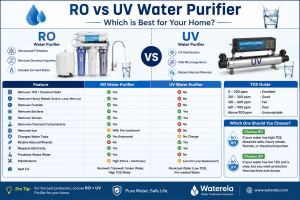
| Feature | RO Water Purifier | UV Water Purifier |
|---|---|---|
| Removes TDS | ✅ Yes | ❌ No |
| Removes Heavy Metals | ✅ Yes | ❌ No |
| Removes Arsenic | ✅ Yes | ❌ No |
| Removes Fluoride | ✅ Yes | ❌ No |
| Removes Salt | ✅ Yes | ❌ No |
| Removes Bacteria | ✅ Yes | ✅ Yes |
| Removes Viruses | ✅ Yes | ✅ Yes |
| Removes Iron | ✅ With pre-treatment | ❌ No |
| Requires Electricity | ✅ Yes | ✅ Yes |
| Produces Waste Water | ✅ Yes | ❌ No |
| Best for High TDS Water | ✅ Yes | ❌ No |
How to Choose the Right Purifier for Your Home
The decision between RO and UV should not be based on price or fancy features; it should be based entirely on your water source and its TDS level.
-
- Test Your TDS Level: Total Dissolved Solids (TDS) measure the amount of salts and minerals in your water. If your water has a TDS level above 300 ppm, an RO purifier is highly recommended to bring it down to safe, drinkable levels.
-
- Evaluate Your Source: If you rely on groundwater or a deep tube well (common in many industrial and residential areas of Gazipur and Chattogram), RO is essential to remove hidden heavy metals.
-
- When to Choose UV: UV is ideal for treated municipal water where the TDS is already low (below 200 ppm), but you need a reliable safeguard against waterborne diseases like typhoid or cholera.
The Ultimate Solution: RO vs UV Water Purifier Systems
For complete peace of mind, many modern water treatment plants and household systems combine both technologies. An RO + UV purifier first pushes the water through the RO membrane to strip out heavy metals and dissolved solids, and then passes it through a UV chamber to guarantee 100% protection against any surviving microbes.
Trust Waterela for Your Water Treatment Needs
Whether you need a compact home filter or a large-scale commercial water treatment plant, understanding your water quality is the first step. Installing the wrong system can lead to unnecessary maintenance costs or leave dangerous contaminants in your glass.
At Waterela, we specialize in providing cutting-edge water treatment plants and purification solutions tailored to the unique water conditions across Bangladesh.
Pure water, Safe Life.
Recommended External Resources (Official)
To learn more about drinking water quality standards and certified water purification systems, visit these trusted organizations:
- Bangladesh Standards and Testing Institution (BSTI) – Bangladesh’s official authority for product standards and quality certification.
- World Health Organization (WHO) – Drinking Water Quality – International guidelines for safe drinking water and public health.